Sfoglia categorie
Esplora
Fiverr Pro
Italiano
$
USD

n8n automation for reconciliation, fee audits and AI verification
Competenze
Consulta i miei servizi

Founder and Automation Engineer
Agba • Lavoratore autonomo
Jan 2026 - Present • 8 mos
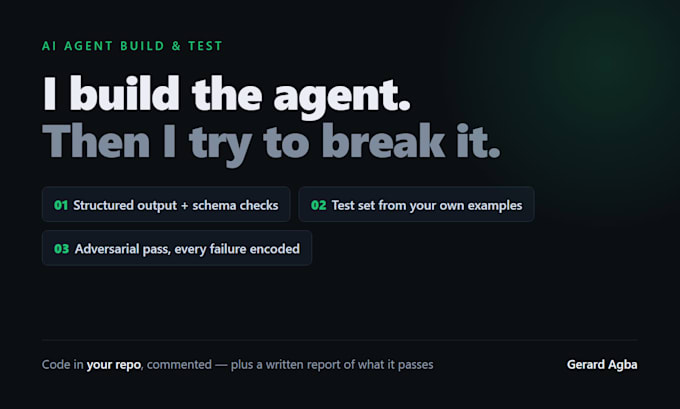
I run a one-person software studio and build the automation I sell here. Two products are live and taking payments. Provenance Capital is a New York commercial mortgage dataset - roughly 24,760 mortgages and $245B in principal - ingested from three public record sources that key on different identifiers and refresh on different cadences, reconciled with deterministic rules and checked against the previous month before anything ships. AnimeCodex is a consumer site sitting on a scheduled pipeline of about twenty modules on the Anthropic API, where nothing publishes until generated output clears a verification stage scored against a defined rubric. The rest of the work is client-shaped: n8n and Python automations that reconcile one system against another - Amazon settlement reports against the published fee schedule, payment processors against the books, sales channels against a single ledger - and report the exceptions with the evidence attached. Customers pay for the data, which means a defect is a refund and not a ticket. That constraint is why I build reconciliation the way I do: deterministic matching, matching run in both directions, tolerance on amounts but never on counts, and a plain sentence on every exception that a bookkeeper can act on without re-deriving it. Stack: n8n, Python, Next.js, Supabase/Postgres, Stripe, OpenAI and Anthropic APIs.

Software Engineer (Apprenticeship)
Flushing Tech • Part time
Apr 2025 - May 2026 • 1 yr 1 mo
A remote apprenticeship on an agile team, contributing to production projects in sprint cycles - requirements, implementation, code review, release. Worked across JavaScript, Python, HTML/CSS and Next.js with teammates in several time zones. The part that mattered most was the review loop. Building alone, you only have to convince yourself. Here every change had to be read, questioned and merged by someone else, and that is where I learned to write code - and commit messages - that explain themselves. It is the same habit behind the way I document automation now: if the person inheriting it cannot follow it without me, it is not finished.
Independent Software Developer
Agba • Freelance
Sep 2021 - Dec 2025 • 4 yrs 3 mos
Before any certification or paid work, I was building in the open. 62 public repositories on GitHub, the first pushed in September 2021. The path was deliberate rather than random. Front end first - HTML, CSS, JavaScript, then TypeScript and React - working through freeCodeCamp and building the small, finishable things that teach you what actually breaks: a calculator, a quiz app, a digital clock, a Jeopardy game, a browser weather extension. Two freeCodeCamp certifications came out of it in late 2024. Then Python, then full applications in Next.js and Svelte. It went from occasional in 2021, to steady through 2024, to near-daily from January 2025. Nobody assigned any of it and nobody was paying. That is where the habits came from: read the error instead of guessing at it, ship something that works before making it elegant, and finish - because a repository nobody else can run is not a project. github.com/agbagerard
