Sfoglia categorie
Esplora
Fiverr Pro
Italiano
$
USD
pcb
TURN A TANGLED PCB INTO A BOARD READY FOR THE FACTORY.
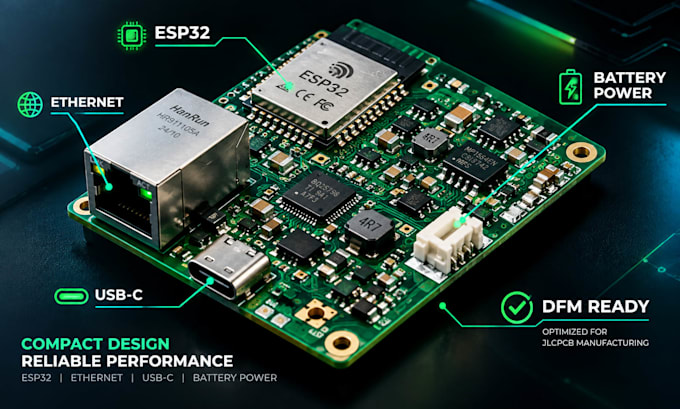
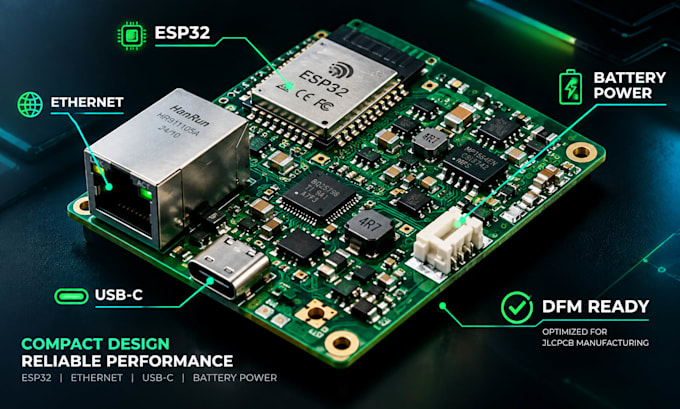
I build compact ESP32 Ethernet PCBs for products that need reliable wired networking, USB-C connectivity, battery power, clean routing, and a practical path to JLCPCB manufacturing.
I focus on the electrical structure, component placement, signal paths, power architecture, and manufacturing constraints before the board reaches production.
SIGNAL PATH:
PRODUCTION EDGE:
BUYER VALUE:
BUILD FOCUS:
Power Integrity
Ground Strategy
Component Placement
Signal Control
Connector Planning
Thermal Awareness
You get more than a PCB file, you get a manufacturing focused board package built around your product requirements.
Send your ESP32 Ethernet requirements, board dimensions, power source, and preferred manufacturing setup. Let's turn your hardware concept into a compact, factory ready PCB.


Piattaforma:
ESP32
Expertise:
Microcontroller
•
Network
•
IoT
Will the compact layout compromise Ethernet or power performance?
No. Compact routing is planned around signal paths, grounding, power distribution, component placement, and required clearances rather than simply squeezing components together.
Can you prepare the board specifically for JLCPCB manufacturing?
Yes. I account for manufacturing constraints and can prepare the required Gerbers, BOM and CPL/placement data for the selected JLCPCB assembly process.
What happens if my USB-C and battery power requirements are unusual?
I first map the power architecture around your actual battery, charging, input protection, voltage rails, and USB-C requirements before committing the circuit structure.
How do I know the ESP32 Ethernet section will be properly integrated?
The Ethernet path is planned around the ESP32, PHY, clocking, magnetics, connector, grounding and routing requirements instead of treating Ethernet as an add-on.
What if I need revisions after reviewing the PCB?
The board is structured so key decisions can be reviewed before manufacturing files are finalized. This helps catch component, connector, footprint, routing, and production issues earlier.