Sfoglia categorie
Esplora
Fiverr Pro
Italiano
$
USD

Academic Writing, Research Papers, LaTeX and Overleaf
Competenze
Consulta i miei servizi
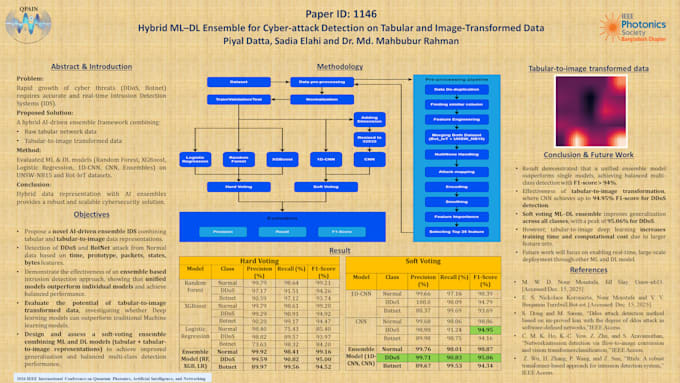

Hybrid ML–DL Ensemble for Cyber-Attack Detection on Tabular and Image-Transformed Data
QPAIN
Apr 2026 - Jun 2026 • 2 mos
The exponential growth of cyber threats, including Distributed Denial of Service (DDoS), Botnet attacks demand advanced intrusion detection systems (IDS) capable of real-time, accurate threat classification. To attain this objective, this research proposes a novel unified AI-driven ensemble intrusion detection framework that integrates both tabular data and tabular-to-image transformed data representations for real-time and accurate threat classification and intrusion detection. Firstly, raw tabular data from both UNSW NB15 and Bot_IoT datasets were preprocessed, encoded, mapped and normalized. Secondly, both tabular data and image-transformed data were integrated to form representations for multi-attack detection. And finally, multiple machine learning and deep learning architectures, including Random Forest, XGBoost, Logistic Regression, 1D-CNN, CNN, along with ensemble models were evaluated to predict DDoS, Botnet, and normal network traffic. Experimental results demonstrate that the ensemble tree-based method achieves superior performance on raw tabular data, achieving an F1-score of 99.16 % for normal network traffic, 95 % for DDoS and 94.52 % for Botnet. Conversely, CNN-based ensemble models excel on image-transformed data, with up to 98.87 % F1-score for normal network traffic detection, 94.34 % for Botnet detection and 95.06 % for DDoS detection, which is the highest. Comparative analysis shows that tabular-to-image-transformed data representations in CNNs consistently improve detection accuracy, F1-score compared to tabular data representations in 1D-CNN. The results highlight the potential of hybrid data representation and AI-driven modeling for robust and scalable network security solutions.

A Data-Driven Usability Evaluation of E-Commerce Interfaces Using Machine Learning
ICCIT 2025
Dec 2025 - May 2026 • 5 mos
Usability measures how effectively a system enables users to complete tasks easily and satisfactorily. In e-commerce applications, usability is essential for designing intuitive systems that enhance user experience and trust. Traditional usability testing methods such as surveys, interviews, and heuristic evaluations are often slower and more subjective than a data-driven approach. Therefore, the objectives of this study are to propose an algorithm for extracting usability scores by utilizing click stream data and to predict usability scores for new users on the platform. To achieve these objectives, at first, a Usability Score Algorithm was developed for extracting usability scores from user interaction data. Then, a click stream dataset representing interaction events was reshaped to count user events. And finally, machine learning models including Linear Regression, Random Forest, SVR, KNN, Decision Tree, and XGBoost were trained to predict the Usability Score. As outcomes, this study showed that XGBoost achieved the best performance with an R^2 of 0.98. Random Forest achieved the second-best performance with an R^2 of 0.95. Feature analysis identified that purchase was the most influential event, while TotalSessions had the least impact. This approach offers a quick and unbiased usability evaluation which will contribute to interaction designers to enhance e-commerce platforms.
